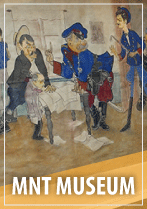
This compelling contemporary drama weaves together multiple languages and diverse life experiences to delve into questions of identity—who we are versus who we believe ourselves to be. Written by Wajdi Mouawad, the innovative Lebanese-Canadian playwright, the story confronts the complexities of the Israeli-Palestinian conflict and its devastating repercussions. The plot centers on a family thrown into chaos as they grapple with profound revelations about their heritage. Following a terrorist attack in Jerusalem, Eitan, a young Israeli-German genetic researcher, falls into a coma, leaving his girlfriend Wahida—an American of Arab descent—to uncover a deeply buried family secret.
CAST
Eitan - Damjan Cvetanovski
Wahida - Sara Klimoska
Eden - Tina Trpkoska
Lea - Zvezdana Angelovska
Nora - Nikolina Kujacha
Etgar - Emil Ruben
David - Nikola Ristanovski
Vazan - Petre Arsovski
Nurse - Saska Dimitrovska
Doctor - Dragana Kostadinovska
CREATIVE AND TECHNICAL TEAM
Translator from French: Kaliopa Petrushevska
Set Designer: Branko Hojnik
Costume Designer: Roza Trajcheska-Ristovska
Dramaturge: Jelena Mijovic
Composer: Irena Popovic-Dragovich
History Advisor: Natalie Zemon Davis
Projection Designer: Milcho Uzunov
Assistant Set Designer: Ilina Angelovska
Executive Producer: Viktor Ruben
Stage Manager: Aleksandar Rajkovski
Prompter: Tanja Ivanovska
Booklet Editors: Mila Angjelkovic and Ivana Jarchevska
Booklet Translator: Marija Dimitrievska
Booklet Proof-reader: Todorka Balova
Booklet Designer: Dimitar Dimitrov
Poster Designer: Zoran Kardula
Photographer: Kire Galevski
Technical Director: Gunter Kube
Technical Coordinator: Jugoslav Aceski
Marketing Manager: Sandra Stojmirova
Lighting Engineer: Daniela Atanasova
Lighting Designers: Igor Gjorgiev and Igor Mitrevski
Lighting Operator: Gorjan Temelkoski
Sound Effects Audio Designers: Aleksandar Petrovski and Stefan Mihajlovski
Sound Technician: Aleksandar Petrovski
Video Operator: Kosta Velkov
Prop Assistants: Sonja Krstevska and Bobi Gelic
Wardrobe Assistants: Valentina Chonkova and Skender Berisha
Tailors: Julijana Dukovska, Biljana Peshevska, Panche Stojmenov
Wig Production: Julie Kacharevic
Make-up Artists and Hair Stylists: Branka Pljackovska and Monika Grkovska
Fly Bar Operators: Ivica Urdarevic and Vasko Bojadziski
Stage Workers: Pavle Kralevski, Zekirija Alim, Nedzhat Asan, Burhan Muaremi, Ibrahim Ramanovski, Husein Halili, Nerhan Osmanovski, Durmish Sefer, Savo Ivanovski, Vasil Meshkovski, Dejan Stamchevski, and Martin Kitanovski
Stagecrafts: Tatjana Hristoska (workshop manager), Darko Bazerko (stagecrafsman), Angel Petrovski (sculptor), Zoran Minovski (blacksmith), and Vladimir Pavlov (blacksmith)
DRAMATURGE'S NOTE
This play defies easy understanding. It resists being confined by words, shifting form, genre, and meaning as it slips through grasp. Elusive yet deeply visceral, it resonates on the skin and beneath it.
Birds of a Kind unfolds in the reading room of a New York library, where a fateful encounter sparks between a Jewish boy and an Arab girl. Their love story is beautiful but fraught, layered with the complexities of identity and history.
It is a drama of discovery—of a boy questioning his father's origins and a girl rediscovering a homeland she sought to forget. It navigates themes of identity, nationhood, and enmity, drawing on the wounds of war, the weight of hatred, and the lies buried in forgotten places.
The play reflects on history’s cycles: the liberation of Jews from Egypt, the crossing of the Red Sea, the wandering in the desert, and the ongoing Israeli-Palestinian conflict. It explores the Holocaust and its enduring legacy—the guilt borne by victims, their descendants, and those who come after, each generation adding weight to an ever-growing burden.
It is about freedom and flight, about walls and divides, about love and hate intertwined. It examines love for the "enemy," the boundaries that separate us, and the prejudices we inherit. It questions what we truly know about ourselves or others.
Woven into the narrative are myths and miracles, stories of figures like El Vazan (Leo Africanus), whose existence is uncertain but whose presence feels undeniable. Languages ebb and flow like rivers, carrying meaning across time and space, spanning continents—America, Europe, Asia, and Africa—and traveling centuries.
This play is a kaleidoscope of emotions and revelations: dark corridors and luminous cracks, secret gardens, and unexpected doors. It meditates on the explosions that have shaped our world—the Big Bang and the ones that continue to echo in headlines, from Beirut to the Crimean Bridge.
Ultimately, Birds of a Kind is a reflection on humanity, love, and the divine—on the idea that if God exists, God is love, and we too often forget. It is a story about the price of existence, the miracles of connection, and the labyrinthine journey of life.
The barriers and walls faced by the characters in this play are not imposed by distant forces but built by people like them—people like us.
In 2006, at Toronto's airport, Wajdi Mouawad, the eventual playwright of Birds of a Kind, crossed paths with American historian and author Natalie Zemon Davis. Captivated by the extraordinary life of Al-Hasan al-Wazzan, Zemon Davis had written Trickster Travels: A Sixteenth-Century Muslim between Worlds, published that year in America and later in France in 2014.
During their brief conversation between flights, Zemon Davis proposed that Mouawad adapt her book into a theatrical work centered on Leo Africanus, Al-Hasan al-Wazzan's adopted European persona. Inspired, Mouawad reimagined the story through the lens of Wahida, a young student researching Al-Hasan's legacy. Thus, Birds of a Kind was born.
In Al-Hasan al-Wazzan's Descriptions of Africa, there is a tale of the amphibious bird—less romantic than Mouawad’s interpretation but rich in symbolism. The bird, seeking to avoid the King of the Birds' tax, transforms into a fish and lives among aquatic creatures for a year. When the King of the Fish demands his own tax, the bird returns to its avian form, constantly reshaping itself to evade the expectations imposed upon it. Moving between worlds, the amphibious bird makes allies in both realms, adapting seamlessly to sky and sea.
This image of the amphibious bird hovers above the play’s darker narrative, mirroring Al-Hasan's journey and transcending boundaries. Like the bird, it defies fixed identities and bridges the divides of ethnicity, politics, and religion.
Ultimately, these shifting, fluid identities offer a glimmer of hope—an aspiration for a world where reconciliation triumphs over division, and love proves more enduring than hate.
Jelena Mijovic, Dramaturge